What Can DP Do too? | ABACUS and DP Reveal Deep Earth Water Reservoir Near Core-Mantle Boundary, Published in Science Advances
Researchers led by Dr. He Yu from the Institute of Geochemistry, Chinese Academy of Sciences, and Associate Professor Zhang Wei from Guizhou Normal University, together with international collaborators, published the paper Absence of dehydration due to superionic transition at Earth’s core-mantle boundary in Science Advances. Combining the domestic ab initio molecular dynamics software ABACUS and Deep Potential Molecular Dynamics (DPMD), the team investigated the thermodynamic stability of water-bearing minerals and water under conditions of Earth’s lower mantle, especially the core-mantle boundary (CMB). The results show that water and the key hydrous mineral δ-AlOOH transform into a special superionic state under extreme high pressure and temperature, which strongly suppresses dehydration.
Research Highlights
Water circulation inside the Earth is critical to understanding planetary evolution and habitability. Conventional theories hold that water carried by subducting slabs gradually dehydrates and releases water as slabs sink into the deep mantle. Nonetheless, the existing form of deep Earth water and its dehydration behavior remain unclear.
This study proves that liquid water cannot stably exist in the lower mantle. Instead, it transforms into superionic ice, where hydrogen ions diffuse freely like liquid within the crystal lattice. Near the CMB (around 140 GPa, 3800 K), δ-AlOOH undergoes a dual superionic transition: both hydrogen and aluminum ions migrate actively within the oxygen framework. The enhanced ion diffusion raises the system entropy and stabilizes the crystal structure, with its melting point remaining at roughly 3800 K under CMB conditions.
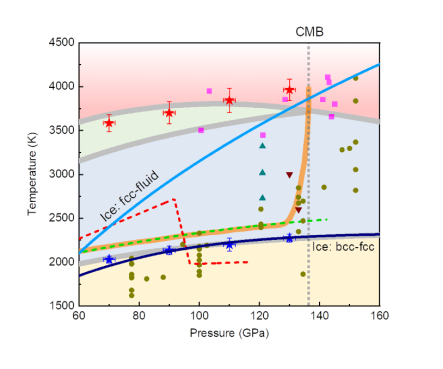
Figure 1: Phase diagram of AlOOH and H₂O at 60–160 GPa and 1500–4500 K. Superionic transitions improve the stability of hydrous phases, enabling AlOOH and H₂O to stay in superionic states in the lower mantle (orange line represents the geotherm).
Further DPMD free energy calculations demonstrate that the dehydration of δ-AlOOH is thermodynamically and kinetically unfavorable in the deep mantle. Since water is trapped as superionic ice, traditional dehydration and water release processes are inhibited. This indicates that ancient water or water transported by subduction may be permanently sealed in the deep Earth, forming a stable long-term water reservoir at the bottom of the lower mantle.
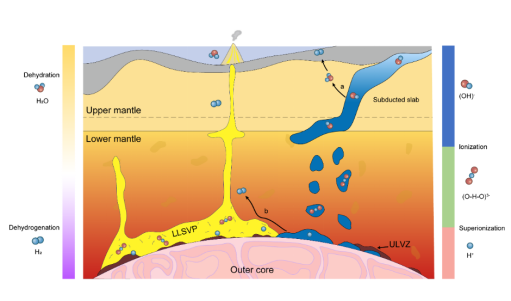
Figure 2: Schematic diagram of deep Earth water circulation. With increasing depth, water evolves sequentially from hydroxyl-bound state (dominated by covalent bonds), symmetric ionized state (dominated by ionic bonds) to superionic state (disordered proton distribution).
Significance and Outlook
This study clarifies how water’s physical state governs deep mantle dehydration at the atomic scale. It offers a new mechanism for interpreting deep water circulation and heterogeneous structures at the CMB, and opens new directions for exploring water preservation and circulation in the early Earth.
The team adopted ABACUS to perform ab initio molecular dynamics simulations on H₂O, δ-AlOOH and Al₂O₃ under lower mantle conditions (1000–5000 K, 60–160 GPa) and generated 10,006 high-precision DFT datasets. The DPMD potential trained on these data accurately reproduces the phase diagram of water, consistent with previous theoretical and experimental results, which verifies its reliability and transferability under high pressure and temperature. This work also proves that ABACUS is highly efficient for simulating high-pressure minerals and deep Earth materials, providing powerful computational support for related geoscience research.
This research was funded by the National Key R&D Program of China (2024YFF0807500) and the Fund for Original Exploration of the National Natural Science Foundation of China (42350002).
Publication Information
He, Y., Zhang, W., Hu, Q., Sun, S., Hu, J., Liu, D., Zhou, L., Dai, L., Kim, D.Y., Redfern, S.A.T., Liu, Y., Li, H., Mao, H.-k. 2026. Absence of dehydration due to superionic transition at Earth’s core-mantle boundary. Science Advances, 12(5), eaeb3006.
DOI: https://www.science.org/doi/10.1126/sciadv.aeb3006
This research was funded by the Young Scientists Project of the Key Research and Development Program of the Ministry of Science and Technology, the International Cooperation and Exchange Project, the General Project of the National Natural Science Foundation of China, and the Key Project of the Natural Science Foundation of Zhejiang Province. It was also supported by the High-Performance Computing Center of Westlake University.